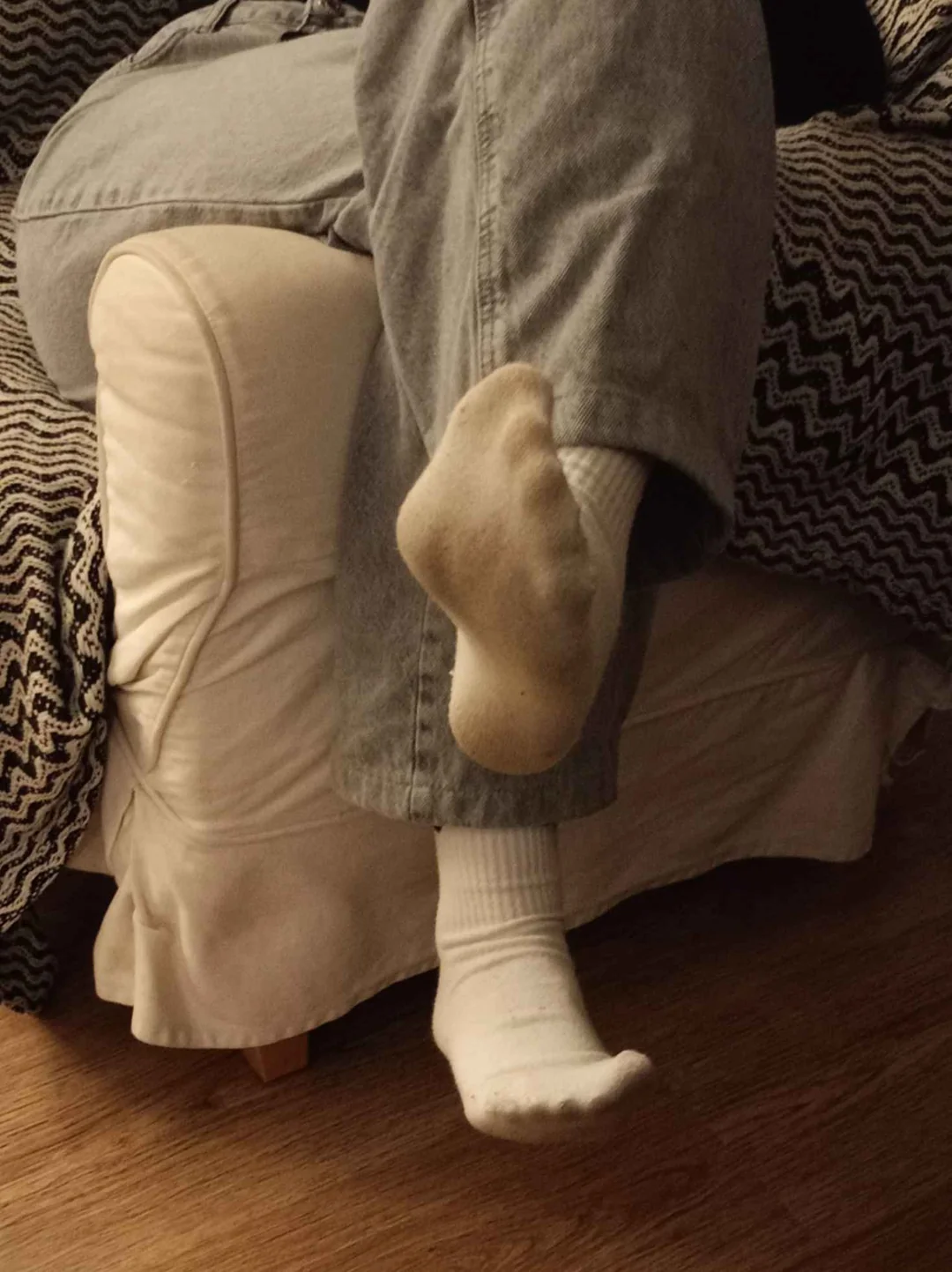
Maybe it’s after a workout. They’re still in leggings, slightly flushed. They are pulling their hair back. They’re wearing white Nike crew socks. The socks are slightly scrunched above the ankle. The kind you’ve seen a thousand times before.
Nothing dramatic really. But your brain quietly zooms in.
Later, you realize that’s the part that stuck. Not the outfit as a whole. Not the setting. Just the socks against the leggings. The contrast. The casual athletic vibe, with the arched feet as she takes off her trainers coming home.
Or maybe it’s the opposite setting. Relaxed. End of the day. Shoes kicked off, but socks still on. That half-undressed, half-comfortable state that feels unintentionally intimate.
That’s often when the realization starts. Just with the subtle awareness that this detail isn’t neutral anymore. And once that clicks, it’s hard to pretend you didn’t notice.
What Even is a Sock Fetish?
At its simplest, a sock fetish is a focused attraction to socks. Visually, physically, or emotionally.
For some people, it’s aesthetic.
Thigh-highs, ankle socks, athletic crews, certain colors or materials.
For others, it’s sensory.
Soft cotton. Worn fabric. The subtle intimacy of something close to the skin.
And sometimes it’s contextual: socks give off a relaxed, at-home, slightly undone energy that can feel surprisingly intimate.
Like most preferences, it exists on a spectrum. For some, it’s a passing interest. For others, it’s a consistent turn-on.
Why Do People Start Developing This Preference?
Human attraction is layered.
Many psychologists agree on how focused turn-ons form. They form early when the brain first links visual cues, emotions, and arousal together. If a specific detail, like socks, appears during formative moments, the brain can note it. This detail becomes quietly stored away.
Over time, that association can strengthen.
There’s also the psychology of contrast. Socks sit in an interesting middle space, not fully dressed, not fully undressed. That “almost” quality can heighten tension. Suggestion often carries more charge than full exposure.
And beyond visuals, there’s atmosphere. Socks are casual. Domestic. End-of-the-day energy. They suggest closeness and comfort. For some people, that emotional undertone plays a bigger role than the fabric itself.
It’s rarely about “just socks.” It’s about what they represent.
Is It Normal?
Focused preferences are far more common than most people assume.
Some people are drawn to leather. Some to uniforms. Some to specific fabrics, accessories, or clothing combinations. A sock fetish falls into that same category. It is a detail that carries more charge for someone than it does for others.
The activity is acceptable as long as it involves consenting adults. It should not cause harm or distress. It’s simply part of the wide spectrum of human sexuality.
The discomfort people sometimes feel tends to come from silence around the topic. Not from the preference itself.
When Does It Become a Concern?
Like any sexual interest, it’s worth reflecting if it causes distress, guilt, or interference with daily life or relationships.
But if it’s simply a preference that enhances attraction, it’s not automatically something that needs to be “fixed.”
Context matters. Emotional impact matters. Self-awareness matters.
Letting Go of the Shame Narrative
The idea that certain attractions are “weird” usually comes from cultural silence, not from science.
Human desire is highly individual. The brain forms associations based on experience, emotion, and sensation — often long before conscious thought enters the picture.
Understanding that can remove a lot of unnecessary self-judgment.
Whether someone personally relates to this preference or simply wants to understand it better, one thing is clear: specificity in attraction is normal.
It’s part of how people are wired.
Final Thought
A sock fetish isn’t a dramatic personality trait. It isn’t a red flag. It isn’t a sign that something is wrong.
It’s a focused preference within a very broad and very human spectrum.
And the more sexuality is approached with curiosity instead of shame, the healthier and more confident people tend to feel — in themselves and in their relationships.
Sometimes understanding something is all it takes to remove its power to feel “strange.”
And sometimes, it turns out it was never strange to start with.
Last updated Mar 1, 2026